Pathways to Legal Status
Last Updated: 4/21/2026
Introduction
Navigating the U.S. immigration system and understanding your rights can feel overwhelming, especially when each process looks different. This resource is designed to serve as a supportive guide in identifying potential pathways to legal status to help you advocate for yourself with confidence.
Undocumented to Legal Statuses
Green Card for Immediate Relatives After Visa Overstay
Source(s): CitizenPath, USCIS
Eligibility
Lawful Entry: The applicant must have been inspected and admitted or paroled into the United States. This means they entered the U.S. through a recognized port of entry with proper documentation;
Immediate Relative Status: The applicant must be the spouse, unmarried child under 21, or parent (if the U.S. citizen child is 21 or older) of a U.S. citizen; and
Admissibility: The applicant must not be inadmissible to the U.S. on other grounds, such as certain criminal convictions or security concerns.
Application Process
Forms I-485, I-130, I-864, and I-693: Family-based applications generally require the application to adjust status, immigrant visa petition and affidavit of support. Exact forms will vary based on relationship type and other factors. A medical exam is mandatory for most applicants, and other forms may be submitted concurrently to request employment authorization and advance parole travel.
Supporting Documents: Provide evidence of the familial relationship, proof of lawful entry (e.g., Form I-94), and documentation demonstrating the applicant's admissibility.
Provisional Unlawful Presence Waiver
Source(s): USCIS
Unlawful presence accrues when an individual remains in the U.S. without authorization. Departing the country after accumulating unlawful presence can trigger reentry bans:
3-year ban: For those with more than 180 days but less than one year of unlawful presence.
10-year ban: For those with one year or more of unlawful presence.
Eligibility for Waiver
The I-601A waiver allows certain individuals to request a waiver of the 3- or 10-year reentry bans before leaving the U.S. for consular processing. To qualify, applicants must:
Be physically present in the United States;
Be at least 17 years old;
Have an approved immigrant visa petition (e.g., Form I-130) and have paid the Department of State's immigrant visa processing fee;
Demonstrate that their U.S. citizen or lawful permanent resident spouse or parent would suffer extreme hardship if the waiver is not granted; and
Believe they are inadmissible solely due to unlawful presence.
There is a filing fee, and the application requires substantial supporting evidence, particularly demonstrating the extreme hardship that a qualifying relative would face if the waiver is denied.
Adjustment of Status under Section 245(i) of the LIFE Act
Source(s): USCIS
Even if an undocumented immigrant has an employer who is willing to sponsor them for a green card, the process still requires the immigrant to return to their home country because of their original unlawful entry or out-of-status condition. Yet, if the individual has 245(i) protection, they can complete the process in the United States and obtain a green card without leaving.
Eligibility
Qualifying Petition: An immigrant petition (such as Form I-130) or labor certification application must have been filed on the applicant's behalf on or before April 30, 2001. This includes petitions filed directly for the individual or derivatively through a parent or spouse.
Physical Presence: If the qualifying petition was filed between January 15, 1998, and April 30, 2001, the applicant must have been physically present in the U.S. on December 21, 2000.
Supplemental Fee: Applicants are required to pay a $1,000 penalty fee in addition to the standard application fees.
Application Process
Form I-485: Submit Form I-485, Application to Register Permanent Residence or Adjust Status, along with applicable filing fees.
Penalty Fee: In addition to the standard filing fees, include the $1,000 penalty fee with the application.
Supporting Documents: Submit evidence of the qualifying petition, proof of identity, relationship to the petitioner, evidence of continuous residence, and all other necessary documentation.
Military Parole in Place for Family Members of U.S. Service Members
Source(s): USCIS
Parole in Place is a special immigration benefit that allows undocumented spouses, children, and parents of active-duty military and veterans to gain temporary permission to remain in the U.S. It also facilitates the green card application process without requiring the individual to leave the country.
Eligibility
Be an immediate family member (spouse, unmarried child under 21, or parent) of a current or former member of the U.S. military;
Currently reside in the United States without a lawful entry; and
Demonstrate that granting parole would benefit the service member or veteran, alleviating hardship.
Application Process
Submit Form I-131: File the Application for Travel Document with USCIS, requesting parole in place.
Provide Evidence: Include proof of the family relationship, military service (e.g., DD Form 214), and evidence of hardship if applicable.
Benefits of Parole in Place
Temporary Legal Status: Approved applicants receive one year of authorized stay in the U.S., renewable annually.
Work Authorization: Individuals may apply for work permits (Employment Authorization Document) during the parole period.
Path to Adjustment of Status: Parole in Place allows eligible individuals to apply for a green card (permanent residency) without leaving the country.
U Visa: Path to Legal Status for Crime Victims
Source(s): USCIS
Eligibility
Victim of a Qualifying Crime: The individual must have suffered substantial physical or mental abuse due to criminal activities such as domestic violence, sexual assault, human trafficking, or other serious offenses.
Assistance to Law Enforcement: Applicants must possess information about the criminal activity and have been, are, or are likely to be helpful in the investigation or prosecution of the crime.
Admissibility: The applicant must be admissible to the United States. If there are grounds for inadmissibility, such as prior immigration violations, a waiver may be available.
Application Process
Must submit Form I-918, Petition for U Nonimmigrant Status, along with evidence of harm suffered. A law enforcement official must complete Form I-918 Supplement B, certifying the applicant's helpfulness in the investigation or prosecution of the crime.
Benefits
Temporary Legal Status: U visa holders receive nonimmigrant status valid for up to four years, with the possibility of extensions in certain circumstances.
Work Authorization: Recipients are eligible to apply for employment authorization, allowing them to work legally in the United States.
Path to Permanent Residency: After three years of continuous presence in the U.S. under U visa status, individuals may be eligible to apply for a green card (permanent residency).
Family Members: Certain family members may also obtain derivative U visas, promoting family unity.
Green Card through Registry for Long-Term Residents
Source(s): USCIS
Eligibility
Continuous Residence: Demonstrate continuous residence in the U.S. since before January 1, 1972.
Good Moral Character: Establish good moral character throughout the period of residence.
Admissibility: Be admissible to the United States, meaning no disqualifying criminal convictions or other grounds of inadmissibility.
No Prior Lawful Admission: Lack a record of lawful admission for permanent residence.
Application Process
Must submit Form I-485, Application to Register Permanent Residence or Adjust Status. Applicants must include substantial supporting documentation to evidence entry, residency, and good moral character.
Pathway to F-1 Visa (Student Visa)
Source(s): US Department of State
Step 1:
Apply to and be accepted by a Student and Exchange Visitor Program (SEVP)-certified school
Meet the program's academic and English language proficiency requirements.
Demonstrate that you have sufficient funds to cover your tuition and living expenses for your entire course of study.
Show proof of having a foreign residence that you intend to return to after your studies.
Step 2:
After acceptance, the school will issue you a Certificate of Eligibility for Nonimmigrant Student Status (Form I-20)
Step 3:
For certain applicants, pay the I-901 Student and Exchange Visitor Information System (SEVIS) fee online.
Step 4:
Complete the Online Nonimmigrant Visa Application, Form DS-160
Step 5:
Schedule a visa interview at a U.S. embassy or consulate in your home country.
Attend the interview and bring all required documents, including your passport, Form I-20, DS-160 confirmation page, SEVIS fee receipt, and any other supporting documents requested by the embassy.
Be prepared to answer questions about your study plans, finances, and ties to your home country.
Pathway to H-1B (Work Visa)
Source(s): USCIS
Step 1:
The applicant must have a job offer for a "specialty occupation" that requires at least a bachelor's degree or equivalent in a related field to the job
The U.S. employer must sponsor the applicant and have a valid employer-employee relationship.
Step 2:
H-1B Registration: The employer registers the candidate in the electronic lottery system during the registration period, which is typically in March
Labor Condition Application (LCA): The employer files an LCA with the Department of Labor to attest that the foreign worker will be paid at least the prevailing wage and that hiring them will not negatively impact U.S. workers.
Form I-129 Petition: If the candidate is selected in the lottery, the employer files Form I-129 with USCIS, which includes the approved LCA and other supporting documents about the job and the applicant
There is a $100,000 fee that must be paid before the petition is filed with USCIS.
Step 3:
USCIS Approval: USCIS reviews the petition. If approved, they will send a notice of approval.
Consular Processing: If the applicant is outside the U.S., they must attend a visa interview at a U.S. embassy or consulate to get the H-1B visa stamp in their passport.
Change of Status: If the applicant is already in the U.S. on another valid visa, they may be able to change their status without leaving the country.
Defensive Asylum Process
Source(s): USCIS
The defensive process is for individuals who have been placed in removal proceedings before an immigration judge.
Process:
The defendant requests asylum as a defense against deportation in immigration court by filing Form I-589 with the court
Receipt notice: The court will send you a receipt notice and notify you of the filing date, which is important for asylum eligibility requirements.
Master Calendar Hearing (MCH): The first hearing is a preliminary hearing where you will confirm the application and get instructions from the judge on next steps.
Individual Hearing: A longer hearing will be scheduled for you to present your case to the judge, including testifying and providing evidence.
Judge's decision: After the hearing, the judge will make a decision on your case.
Decision: The judge may issue the decision during the hearing or send a written ruling later.
If you are granted asylum: You will be protected from deportation and can apply for a green card later.
If asylum is denied: The judge will determine if you are eligible for other forms of relief. If not, they will order you to be removed.
Appeals: If the judge denies your asylum claim, you have the right to appeal the decision to the Board of Immigration Appeals within 30 days.
Affirmative Asylum Process
Source(s): USCIS
Eligibility
Presence in the U.S.: Applicants must be physically present in the United States, regardless of their method of entry.
Persecution or Fear Thereof: Applicants must have experienced past persecution or possess a well-founded fear of future persecution in their home country.
Protected Grounds: The persecution must be due to race, religion, nationality, membership in a particular social group, or political opinion.
Application Deadline: Generally, individuals must apply for asylum within one year of their arrival in the United States.
Application Process
The asylum application process begins by submitting Form I-589, Application for Asylum and for Withholding of Removal, to USCIS. There is no filing fee for this form.
Benefits
Legal Residence: Asylees are authorized to live in the United States indefinitely.
Employment Authorization: Asylees may apply for employment authorization, allowing them to work legally in the U.S.
Path to Permanent Residency: After one year of continuous presence in the U.S. as an asylee, individuals may apply for a green card (permanent residency).
Family Reunification: Asylees can petition to bring their spouse and unmarried children under 21 to the United States.
Other considerations
You may not be eligible if you can be removed to a safe third country or if a previous asylum application has been denied.
Burden of proof: You must provide convincing evidence for both a subjective fear and an objective basis for that fear.
Referrals
If possible, please consult with an immigration lawyer before filing any forms.
https://www.immigrationadvocates.org/legaldirectory/
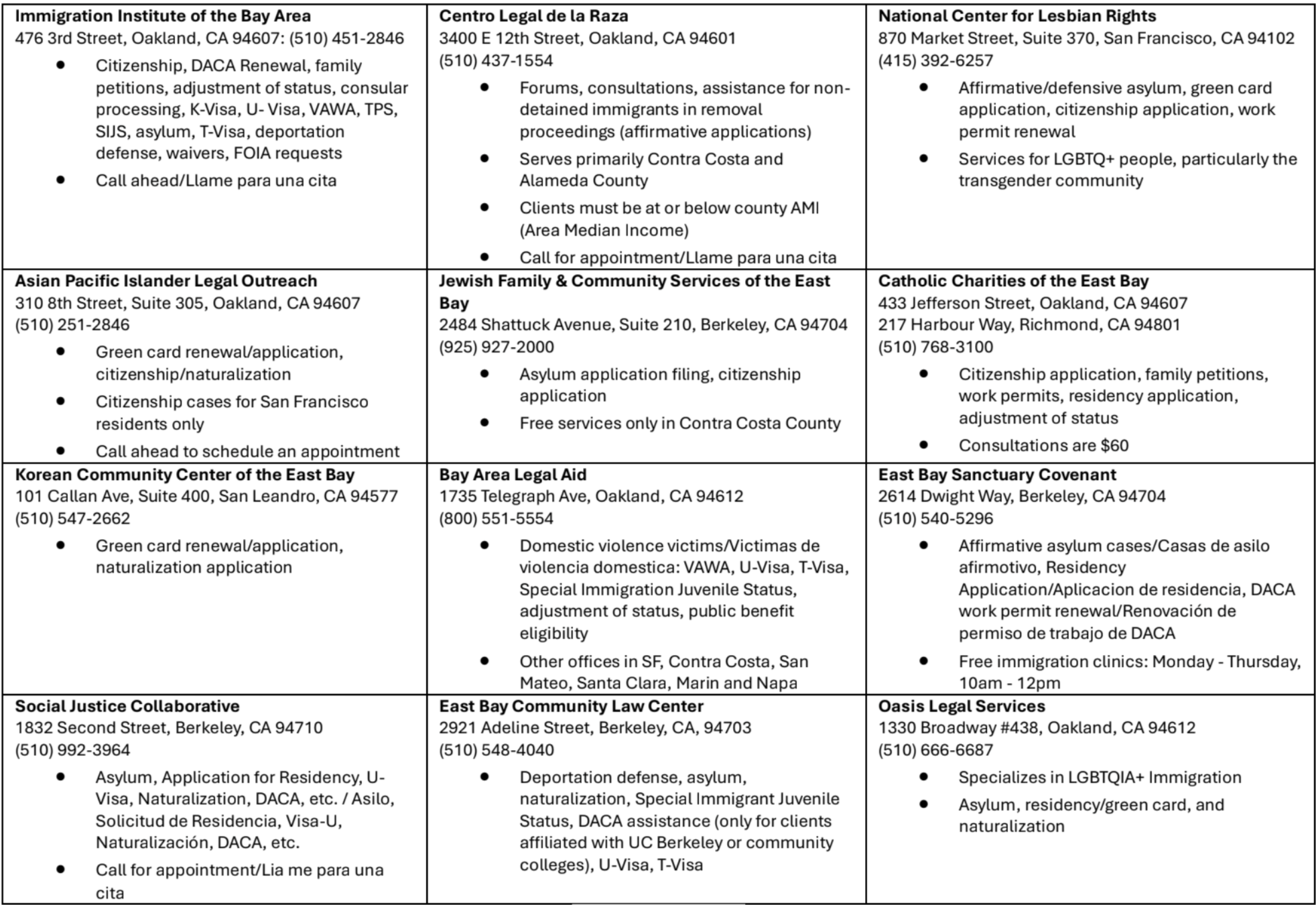
Bay Area Immigration Resources
Disclaimer
This document is for general informational purposes only and is not legal advice. For guidance on your specific situation, consult an employment attorney or legal aid organization. For additional questions, feel free to contact us at legalclinic@asuc.org.
Sources
General
U.S. Citizenship and Immigration Services. (n.d.). USCIS. Retrieved from https://www.uscis.gov/
Undocumented to Legal Status
CitizenPath. (n.d.). Applying for a Green Card After a Visa Overstay Retrieved from https://citizenpath.com/visa-overstay-usa-green-card/
U.S. Citizenship and Immigration Services. (n.d.). Green card for immediate relatives of a U.S. citizen. Retrieved from https://www.uscis.gov/green-card/green-card-eligibility/green-card-for-immediate-relatives-of-us-citizen
U.S. Citizenship and Immigration Services. (n.d.). Provisional unlawful presence waivers. Retrieved from https://www.uscis.gov/family/family-of-us-citizens/provisional-unlawful-presence-waivers
U.S. Citizenship and Immigration Services. (n.d.). Green card through INA 245(i) adjustment. Retrieved from https://www.uscis.gov/green-card/green-card-eligibility/green-card-through-ina-245i-adjustment
U.S. Citizenship and Immigration Services. (n.d.). Discretionary options for military members, enlistees, and their families. Retrieved from https://www.uscis.gov/military/discretionary-options-for-military-members-enlistees-and-their-families
U.S. Citizenship and Immigration Services. (n.d.). Victims of criminal activity: U nonimmigrant status. Retrieved from https://www.uscis.gov/humanitarian/victims-of-criminal-activity-u-nonimmigrant-status
U.S. Citizenship and Immigration Services. (n.d.). Green card through registry. Retrieved from https://www.uscis.gov/green-card/green-card-eligibility/green-card-through-registry
Pathway to F-1 Visa (Student Visa)
U.S. Department of State. (n.d.). Student visa. Travel.State.Gov. Retrieved from https://travel.state.gov/content/travel/en/us-visas/study/student-visa.html
Pathway to H-1B (Work Visa)
U.S. Citizenship and Immigration Services. (n.d.). H-1B specialty occupations. Retrieved from https://www.uscis.gov/working-in-the-united-states/h-1b-specialty-occupations
Defensive and Affirmative Asylum Processes
U.S. Citizenship and Immigration Services. (n.d.). Obtaining asylum in the United States. Retrieved from https://www.uscis.gov/humanitarian/refugees-and-asylum/asylum/obtaining-asylum-in-the-united-states
Green Card Eligibility — Family Based
U.S. Citizenship and Immigration Services. (n.d.). Green card for immediate relatives of a U.S. citizen. Retrieved from https://www.uscis.gov/green-card/green-card-eligibility/green-card-for-immediate-relatives-of-us-citizen
U.S. Citizenship and Immigration Services. (n.d.). Green card for family preference immigrants. Retrieved from https://www.uscis.gov/green-card/green-card-eligibility/green-card-for-family-preference-immigrants
U.S. Citizenship and Immigration Services. (n.d.). Green card for fiancé(e) of a U.S. citizen. Retrieved from https://www.uscis.gov/green-card/green-card-eligibility/green-card-for-fiancee-of-us-citizen
U.S. Citizenship and Immigration Services. (n.d.). Green card for widower of a U.S. citizen. Retrieved from https://www.uscis.gov/green-card/green-card-eligibility/green-card-for-widower-of-a-us-citizen
U.S. Citizenship and Immigration Services. (n.d.). Green card for VAWA self-petitioner. Retrieved from https://www.uscis.gov/green-card/green-card-eligibility/green-card-for-vawa-self-petitioner
Green Card Eligibility — Employment Based
U.S. Citizenship and Immigration Services. (n.d.). Employment-based immigration: First preference EB-1. Retrieved from https://www.uscis.gov/working-in-the-united-states/permanent-workers/employment-based-immigration-first-preference-eb-1
U.S. Citizenship and Immigration Services. (n.d.). Employment-based immigration: Second preference EB-2. Retrieved from https://www.uscis.gov/working-in-the-united-states/permanent-workers/employment-based-immigration-second-preference-eb-2
U.S. Citizenship and Immigration Services. (n.d.). Green card through a physician national interest waiver (NIW). Retrieved from https://www.uscis.gov/green-card/green-card-eligibility/green-card-through-a-physician-national-interest-waiver-niw
U.S. Citizenship and Immigration Services. (n.d.). Green card for immigrant investors. Retrieved from https://www.uscis.gov/green-card/green-card-eligibility/green-card-for-immigrant-investors
Determining Citizenship in Special Circumstances
Immigrant Legal Resource Center. (n.d.). Acquisition and derivation quick reference charts. ILRC. Retrieved from https://www.ilrc.org/resources/acquisition-derivation-quick-reference-charts